
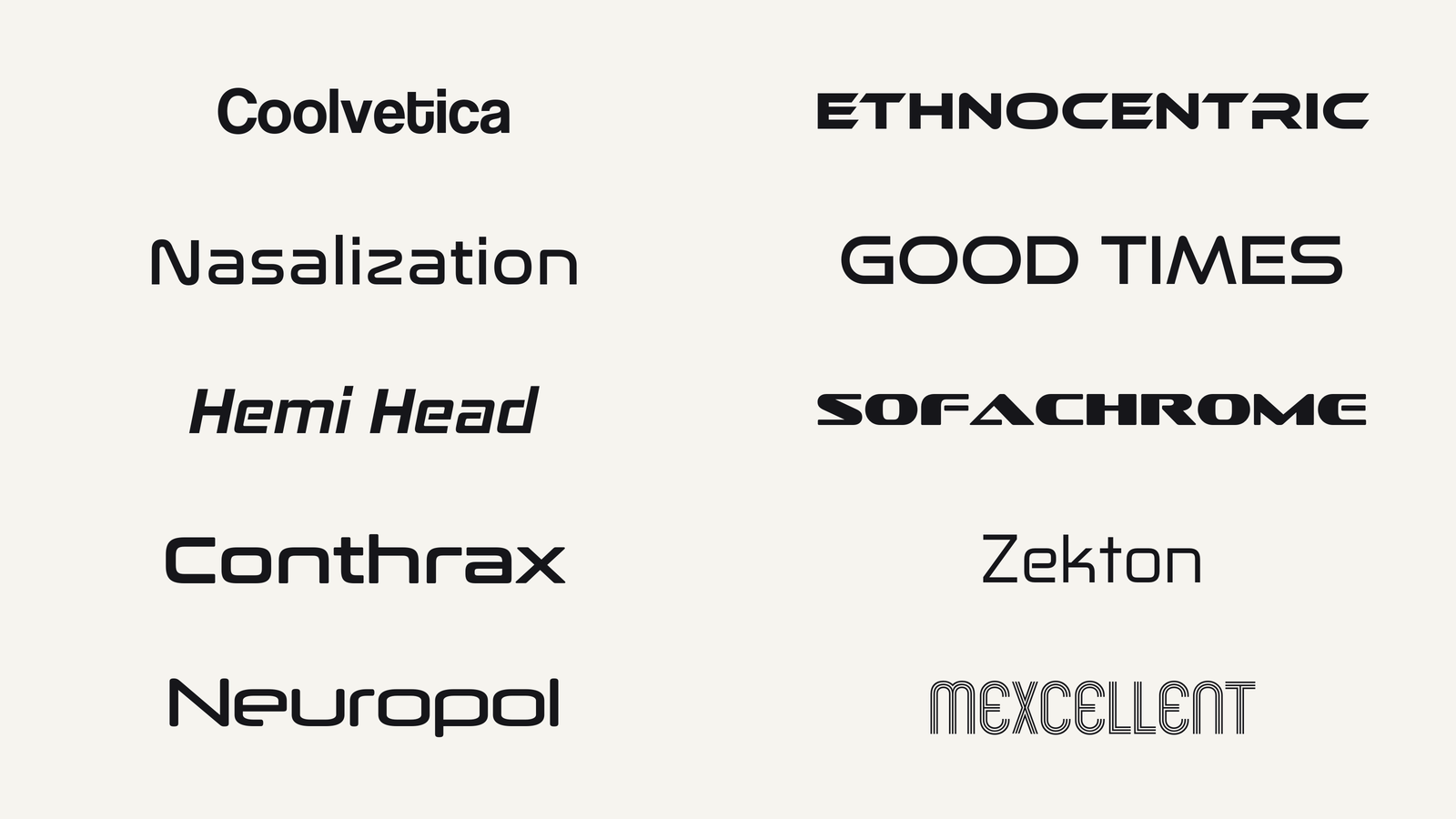
Typodermic Fonts, the foundry of designer Raymond Larabie, gives away more fonts than almost any commercial foundry: 249 fonts under a free desktop license and 729 older fonts in the public domain. Many of the most recognizable free display fonts, from Coolvetica to Good Times, come from these two packages. But they come with two very different licenses, and the desktop one has limits that most download sites leave out. This guide explains both, section by section, using the license files themselves.
Two free packages, two different licenses
Both packages are on typodermicfonts.com/downloads. As we downloaded them on 17 October 2026:
| Free desktop fonts | Public domain fonts | |
|---|---|---|
| Size | 11.5 MB ZIP, 249 OTF fonts | 22.8 MB ZIP, 729 OTF fonts |
| License | Typodermic Desktop EULA v260817 (PDF in the ZIP) | Creative Commons Zero (CC0) |
| Commercial artwork | Yes | Yes |
| Websites, apps, games | No, needs a paid license | Yes |
| Templates, redistribution, modification | No | Yes |
| Typical fonts | Current releases: Coolvetica, Good Times, Ethnocentric, Conthrax | Older releases, such as the original 1996 Neuropol |
The public domain license fits in two sentences: “Please do not ask permission to do anything with these fonts. Whatever you want to do with this font, the answer will be yes.” The rest of this guide is about the desktop license, because that is where people get caught out.
Where to download safely
The desktop license (section 9) defines an Authorized Download Source as Typodermic’s own website or a distributor it authorized, and names DaFont and 1001 Fonts as current examples. Copies from those sources come with the license. Two other points from the license and Typodermic’s licensing page are worth knowing:
- A site calling a font “free” does not change anything. Section 8.5 says a distributor’s “free” label does not change the agreement, and section 9 says a site’s own description does not make it an authorized source.
- MyFonts sells the same styles. Typodermic’s licensing page notes that MyFonts “now charges for those same styles and no longer offers free license tiers for them”. A free download from Typodermic or DaFont does not include a MyFonts webfont license.
What the free desktop license allows, section by section
The license is the Typodermic Font Software for Desktop End User License Agreement, version v260817, effective August 17, 2026. It is ten pages long. These are the parts that decide what you can do:
Allowed
- Install on your own computers (2.1). A licensed user may install the fonts on the desktop and laptop computers assigned to them.
- Commercial finished artwork (2.2). You may “create, edit, view, print, and distribute materials for commercial or non-commercial purposes” if the materials do not contain the font file and the lettering is fixed artwork. The license lists print, logos, packaging, merchandise, presentations, images and rendered video.
- Non-commercial PDFs with the font embedded (2.3), as long as recipients cannot edit or extract it. A PDF sold as a product needs a separate license; a commercial PDF with outlined text counts as artwork.
- Backups (2.4), kept under your control.
- Naming the font (2.5). You can say which Typodermic font you used, without implying endorsement.
- No volume limit (3.2) on finished materials: print a million posters if you like.
- Editing outlined letters (4.2). Changing letterforms after converting them to vector outlines or pixels is not modifying the font. Custom logo work is fine.
- Perpetual (7.1). No expiry, renewal or fee.
Not allowed
- More than one person (3.1), unless your download says otherwise. Companies count every employee who can use the font; contractors, agencies and clients are not covered by your copy and need their own.
- Sharing the files (4.1). No uploading, lending or giving the font to others; they download their own copy.
- Modifying the font files (4.2), converting, subsetting or renaming them.
- Embedding (4.3) in a website or webfont, an app or game, an editable template or theme you give to others, a server or software-as-a-service product, an automated image generator, a print-on-demand or personalization system, or any hardware.
- Servers and cloud font services (4.4), including shared drives and digital asset management systems used as a font source.
- Glyph products (4.5): substitute fonts, letter sets, embroidery alphabets, cutting-machine alphabets or any product that lets someone compose new text from the typeface.
- Open-source projects (4.6) whose license would require the font to be redistributed or modified.
- AI training (4.7) on the fonts, their outlines or rendered images of them.
Common situations
| Situation | Free desktop license? |
|---|---|
| A logo you design for a client, delivered as vector artwork | Yes |
| Handing the client the font file with the logo | No. The client downloads their own copy. |
| YouTube thumbnails, social posts, video titles | Yes |
| A T-shirt design you upload as a PNG to a print-on-demand shop | Yes, that is finished artwork |
| A shop feature that lets customers type their own text in the font | No (personalization system) |
| Live headings on your website | No. Use an image, or buy a Webfonts license. |
| A Canva or Figma template you sell | No (editable template) |
| Uploading the font to a shared Canva brand kit | Unclear; section 4.4 bans cloud font services. Ask Typodermic first. |
| Cricut or embroidery alphabet files for sale | No (glyph product) |
| Your five-person design team | Each person downloads their own copy, or the company buys a multi-user license |
| A paid e-book with the font embedded | No. Outline the text or buy an Electronic Doc license. |
We are not lawyers. The license PDF in the ZIP is the document that counts; read it if a project depends on it.
When you need a paid license
For anything the desktop license does not cover, Typodermic points to MyFonts, which sells Desktop (more users), Company Desktop, Webfonts, App, Electronic Doc, Digital Ad/Email and Server licenses. Across the families we checked on 17 October 2026, a single style costs $69.95 for one desktop user, while complete families cost $84.95 to $169.95. That makes the family the cheaper option as soon as you need two or three paid styles. Each guide below has the full price table for that family.
The free Typodermic fonts we cover
| Font | Free styles | Guide |
|---|---|---|
| Coolvetica | Regular, Italic, Condensed, Crammed, Heavy Compressed | Coolvetica free download |
| Ethnocentric | Regular, Italic | Ethnocentric free download |
| Nasalization | Regular | Nasalization free download |
| Good Times | Regular | Good Times free download |
| Hemi Head | Bold, Bold Italic | Hemi Head free download |
| Sofachrome | Regular, Italic | Guide coming soon |
| Conthrax | Semi Bold | Guide coming soon |
| Zekton | Regular | Guide coming soon |
| Neuropol | Original (public domain); Neuropol X Regular (desktop) | Guide coming soon |
| Mexcellent | Regular, 3D | Guide coming soon |
Written by Thinh Tran. FontCompass earns a commission on purchases made through MyFonts links in our guides, at no extra cost to you. License terms and prices were checked on 17 October 2026 and can change.


Leave a Reply